The Delegation Diligence Loop
Teaching AI Fluency
Anthropic
  Open in Claude


                ## What you'll learn
Estimated time: 40 minutes
By the end of this lesson you'll be able to:
- Help students leverage the Delegation-Diligence loop for responsible design and decision making
The Delegation-Diligence loop
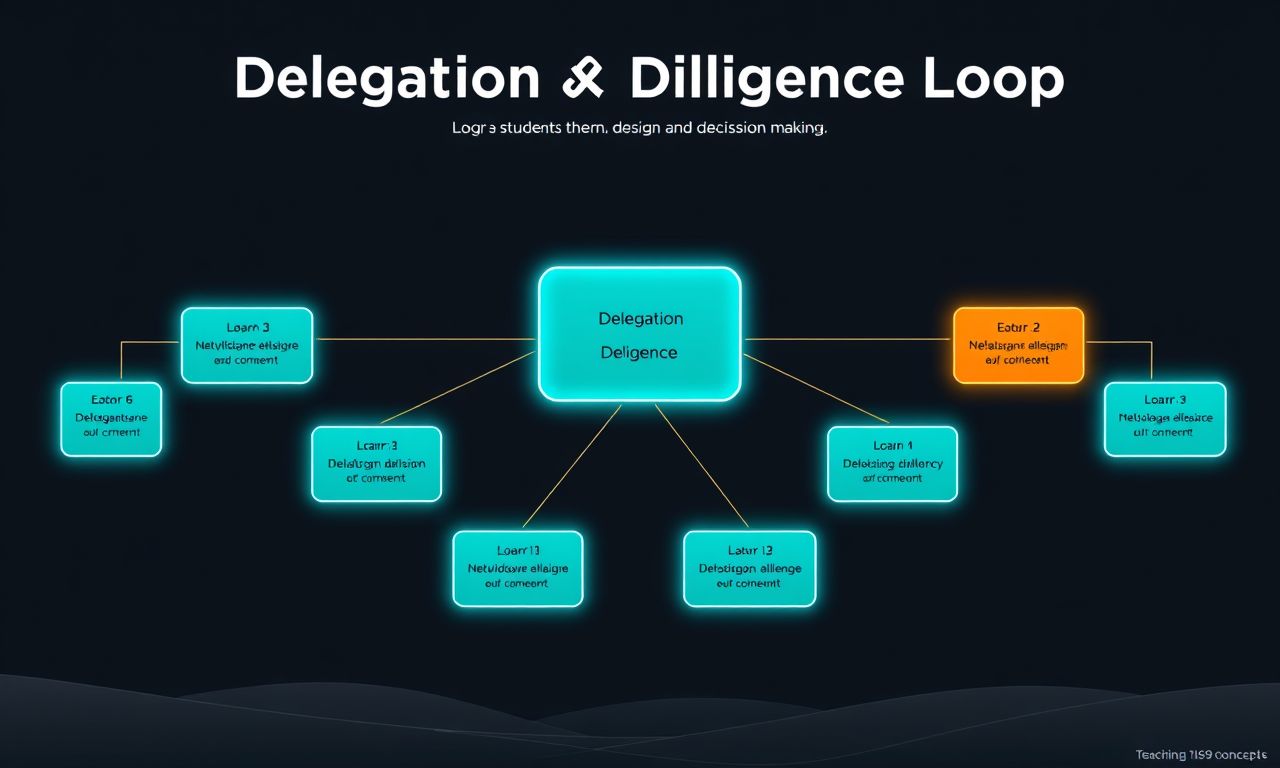
This video explores how to teach the Delegation-Diligence loop as a framework for responsible design and decision-making in AI collaboration. The loop addresses strategic and ethical questions about whether, when, and how to use AI, moving beyond "how do I use AI?" to "how do I make good decisions about AI?" The video demonstrates the two-way relationship between these competencies: Delegation decisions raise Diligence questions, and Diligence considerations reshape Delegation strategies. It provides concrete strategies for helping students recognize these connections, including step-by-step guides for navigating the loop in both directions and exercises that make the connections visible. The video emphasizes that when students understand how these competencies work together, they learn to see constraints not as limitations but as creative catalysts that clarify and strengthen their collaboration choices.
Key takeaways
- The Delegation-Diligence loop handles big-picture strategic and ethical decision-making about AI use
- Delegation and Diligence each informs and shapes the other — the loop runs both ways
- Teaching through scenarios helps students see connections rather than treating competencies as checkboxes
- Students who master this loop develop clear rationales for their choices and can articulate why their approach aligns with goals and values
- Accountability and transparency enhance rather than limit creative possibilities with AI
Exercises
This exercise helps you create a concrete lesson plan for teaching the Delegation-Diligence loop.
Step 1: Creating Your Loop Scenario (10 minutes)
Continue the conversation from Exercise 1, and let your AI partner know that you are designing a Delegation-Diligence loop focused lesson:
-
Work with the AI to create a realistic scenario/workflow from your discipline
-
Include specific details that will enable students to think about nature of work, human and AI capabilities and limitation, ethics, transparency, and accountability
-
Create decision points where students must navigate between strategic choices and ethical considerations
-
Plan how students will document their thinking as they work through the scenario
Part 2: Structuring the Learning Experience (20 minutes)
Designing the forward flow (Delegation to Diligence):
- Create a structured worksheet or guide that helps students start with problem awareness and platform selection
- Design prompts that help students recognize when their Delegation decisions raise ethical questions
- Include checkpoints where students must consider transparency and accountability
- Plan how students will document the connection between their strategic choices and ethical implications
Designing the reverse flow (Diligence to Delegation):
- Create a variation where students start with ethical constraints or transparency requirements
- Design activities that show how these constraints can clarify and improve task delegation
- Include reflection prompts that help students see accountability as empowering rather than limiting
- Plan how students will recognize that responsible practices enhance rather than restrict possibilities
(Optional) Export as executable plan :
- Ask the AI to help you compile your scenario, activities, and assessment into a complete lesson plan
- Include clear learning objectives that emphasize loop thinking
- Provide step-by-step facilitation notes for yourself
- Create student-facing materials including worksheets and reflection prompts
What's next
In the next lesson, we'll explore the Description-Discernment loop, which focuses on the moment-to-moment craft of building cognitive environments where humans and AI work together effectively.
Feedback
As you progress through the course, we'd love to hear from you about how you are using concepts from the course in your life, work, or classes and any feedback you may have. Share your feedback here.
Acknowledgments and license
Copyright 2025 Rick Dakan, Joseph Feller, and Anthropic. Released under the CC BY-NC-SA 4.0 license. This course is based on The AI Fluency Framework by Dakan and Feller.Supported in part by the Higher Education Authority, Ireland, through the National Forum for the Enhancement of Teaching and Learning.
                        #### Downloads

                        - TAIF_TRANSCRIPT_02_DEL_DIL.txt