Welcome Approaches To Teaching AI Fluency
Teaching AI Fluency
Anthropic
  Open in Claude


                ## What you'll learn
Estimated time: 60 minutes
By the end of this lesson you'll be able to:
- Select and adapt teaching approaches for teaching the AI Fluency Framework to your students
- Design learning experiences using linear, non-linear, focused, or loop-based approaches
Welcome & approaches to teaching AI Fluency
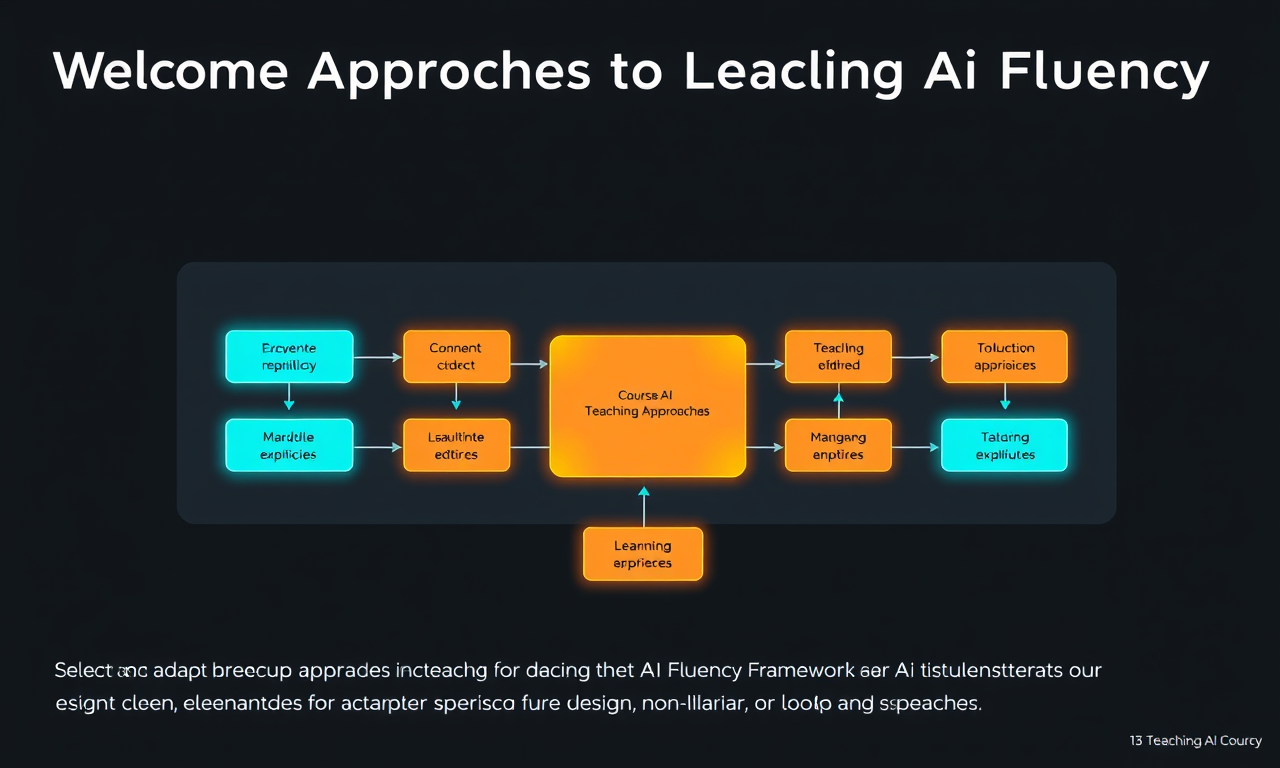
This video welcomes educators who have already been working with the AI Fluency Framework and are ready to teach it to others. It covers the structure of the course and introduces four distinct approaches for teaching the AI Fluency Framework: the linear approach (moving step-by-step from Delegation through Description, Discernment, to Diligence), the non-linear approach (starting anywhere and moving flexibly between competencies), the focused approach (deep diving into a single competency), and the two-loops approach (teaching the framework as nested strategic and tactical processes). The video emphasizes that the AI Fluency Framework operates on two levels, as it both describes what happens when people work with AI and guides them toward better practices. Understanding this dual nature is crucial for teaching, as students need to grasp both how AI interactions work and how to improve them.
Key takeaways
- The AI Fluency Framework serves as both a descriptive model and a normative guide for AI interaction
- Four teaching approaches offer different entry points suited to different student contexts and learning objectives
- The linear approach works best for beginners who need structure and sequential building of skills
- More experienced students benefit from non-linear or loop-based approaches that reflect real-world complexity, or focused approaches that provide greater depth
- Your choice of approach should match your students' readiness, available time, and learning goals
Exercises
This exercise helps you establish your teaching context and explore how each approach might work for your students.
Step 1: Mapping Your Teaching Context (10 minutes)
Start a conversation with Claude (for convenience, we will refer to Claude in many of these examples. However, there is nothing in this course that requires you to use any specific language model or any particular company’s product. You can work with whichever is your preferred AI assistant or indeed a combination of several different models/products.)
Before you begin:
- Share the fluency summary attached to this lesson with the AI so it can understand which Framework you mean
- Share the video transcripts (see Lesson 1 resources) with the AI so they understand the four teaching approaches
Opening the conversation:
- Begin by explaining that you're an educator preparing to teach the AI Fluency Framework
- Share essential information about your teaching situation and course details
- Describe your students' backgrounds (protecting personal data, of course), their typical experience with AI, and their motivations for learning
- Discuss any specific constraints you face such as limited class time, technology access, or institutional policies
Key areas to explore with the AI:
- Ask the AI to help you think through what makes your teaching context unique
- Discuss your students' likely strengths and challenges when learning about AI collaboration
- Explore what success would look like for your students after completing your instruction
- Consider what resources and support systems you have available
Create a teaching context document:
- Ask the AI to synthesize this discussion into a structured summary of your teaching context
- Review this summary to ensure it captures all essential elements
- Save this document and reuse when starting new teaching conversations (such as those in lessons 2 and 3) with your AI partner to quickly establish context
Step 2: Designing with Different Approaches (20 minutes)
Continue your conversation to explore how each approach would work for your context.
Designing using a linear approach:
- Work with the AI to sketch out how you'd teach the 4Ds sequentially (Delegation to Description to Discernment to Diligence) in your context
- Ask the AI to help you identify specific activities for each competency, and the transitions between them, that would best resonate with your students
- Discuss potential challenges with the AI about this structured approach for your particular students
Designing using a non-linear approach:
- Work with the AI to identify a few subject-relevant scenarios that would enable your students to engage in this approach.
- Explore with the AI which D might be the best starting point for a specific scenario/your students and why
- Work with the AI to map out criteria for which competency to address at different points in the workflow based on your students’ goals and constraints
Designing using a focused approach:
- Identify which single D would provide the most value given your constraints
- Plan how to dive deep into all three sub-components of your chosen competency
- Design activities that thoroughly explore your chosen D from multiple angles
Note that we’ll work on designing loop-based lessons in parts 2 and 3 of this lesson.
What's next
In the next lesson, we'll explore the Delegation-Diligence loop, a framework for responsible design and decision-making in AI collaboration.
Feedback
As you progress through the course, we'd love to hear from you about how you are using concepts from the course in your life, work, or classes and any feedback you may have. Share your feedback here.
Acknowledgments and license
Copyright 2025 Rick Dakan, Joseph Feller, and Anthropic. Released under the CC BY-NC-SA 4.0 license. This course is based on The AI Fluency Framework by Dakan and Feller.Supported in part by the Higher Education Authority, Ireland, through the National Forum for the Enhancement of Teaching and Learning.
                        #### Downloads

                        - AI Fluency_ Key Terminology Cheat Sheet.pdf
- 1.2 AI Fluency Summary.pdf
- Framework_for_AI_Fluency_V_1.5.pdf
- TAIF_TRANSCRIPT_01_WELCOME.txt