The Description Discernment Loop
Teaching AI Fluency
Anthropic
  Open in Claude


                ## What you'll learn
Estimated time: 40 minutes
By the end of this lesson you'll be able to:
- Help students leverage the Delegation-Diligence loop for responsible design and decision making
The Description-Discernment loop
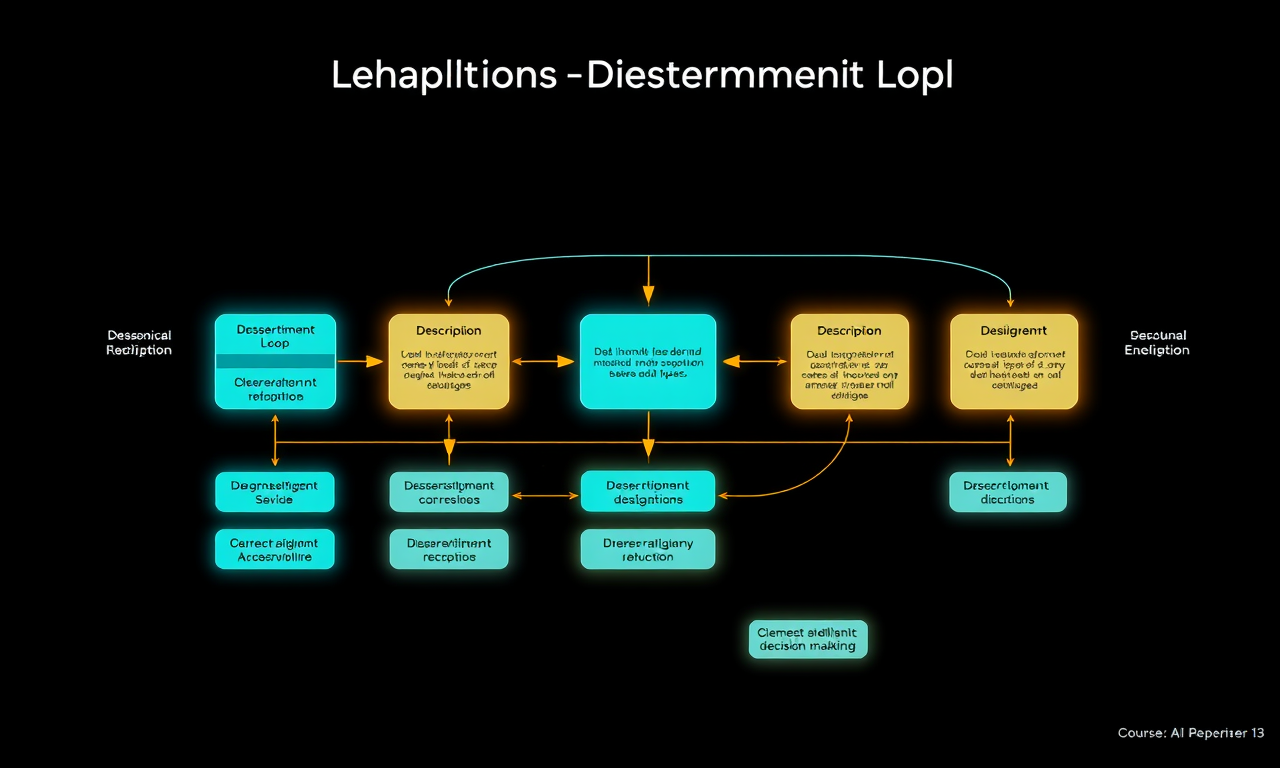
This video examines the Description-Discernment loop, which focuses on the moment-to-moment craft of building cognitive environments where humans and AI work together effectively. Moving beyond single prompts to sustained conversations, this loop teaches students to build shared context and understanding with AI. The video focuses on Product, Process, and Performance as three lenses for understanding collaboration—what we're creating, how we're approaching it, and how we're interacting. It emphasizes that students often arrive thinking about "prompt tricks" but need to develop a more sophisticated understanding of building genuine collaborative relationships with AI. The video provides strategies for teaching cognitive environment building, including designing assignments that require multiple interactions over time, sharing your own AI collaboration process, and encouraging students to document the evolution of their interactions. It concludes by showing how the two loops work together, with Delegation-Diligence setting strategic direction and Description-Discernment filling that container with rich, iterative interaction.
Key takeaways
- The Description-Discernment loop transforms AI interaction from commands to conversations that use context to build cognitive environments
- Product, Process, and Performance operate as different lenses for understanding the same collaborative process
- Teaching this loop means helping students move beyond automation to genuine augmentation
- Successful cognitive environments include shared vocabulary, established interaction patterns, and mechanisms for building on previous exchanges
- The two loops work as nested systems—strategic decisions create the container that tactical interactions fill
Exercises
This exercise helps you create a concrete lesson plan for teaching the Description-Discernment loop.
Part 1: Creating Your Loop Scenario (10 minutes)
Continue the conversation from Exercise 2, and let your AI partner know that you are designing a Description-Discernment loop focused lesson based on the same scenario as in the previous exercise.
Developing a scenario for your students:
-
Discuss with the AI the need to shift from the Delegation-Diligence loop to the Description-Discernment loop
-
Work with the AI to create elements that help students explore how Product, Process, and Performance descriptions evolve through Discernment and iteration
-
Plan how students will document the evolution of their shared context with AI
Part 2: Structuring the Learning Experience (20 minutes)
Designing the Product evolution:
- Work with AI to create a progression where students start with vague goals and iteratively clarify them
- Discuss how to help students recognize when and how their vision of "good" is evolving
- Include checkpoints where students document how their product understanding changes
Designing the Process development:
- Work with AI to create a progression where students develop shared problem-solving methods with AI over time
- Discuss how to help students recognize when and how their preferred problem-solving approach is evolving
- Include checkpoints where students document how their Process understanding changes
Designing the Performance relationship:
- Work with AI to create a progression where students experiment with different interaction styles and their effects
- Discuss how to help students recognize when and how AI behaviors are appropriate and useful to their goals
- Include checkpoints where students document how their Process understanding changes over time
(Optional) Export as executable plan :
- Ask the AI to help you compile your scenario, activities, and assessment into a complete lesson plan
- Include clear learning objectives that emphasize loop thinking
- Provide step-by-step facilitation notes for yourself
- Create student-facing materials including worksheets and reflection prompts
Reflection
- Which approaches best fit your learning objectives for your students?
- Which approaches best fit your personal teaching style and preferences?
What's next
In the next lesson, we'll explore how to assess AI Fluency in your students. You'll learn to apply outcome, process, and reflection-based assessment strategies and create rubrics that capture the 4D competencies.
Feedback
As you progress through the course, we'd love to hear from you about how you are using concepts from the course in your life, work, or classes and any feedback you may have. Share your feedback here.
Acknowledgments and license
Copyright 2025 Rick Dakan, Joseph Feller, and Anthropic. Released under the CC BY-NC-SA 4.0 license. This course is based on The AI Fluency Framework by Dakan and Feller.Supported in part by the Higher Education Authority, Ireland, through the National Forum for the Enhancement of Teaching and Learning.
                        #### Downloads

                        - TAIF_TRANSCRIPT_03_DES_DIS.txt