AI Fluency Framework
AI Fluency for students
Anthropic
  Open in Claude


                Estimated time: 30 minutes
What you'll learn
By the end of this lesson you'll be able to:
- Define AI Fluency means and explain why it matters for your academic and professional future
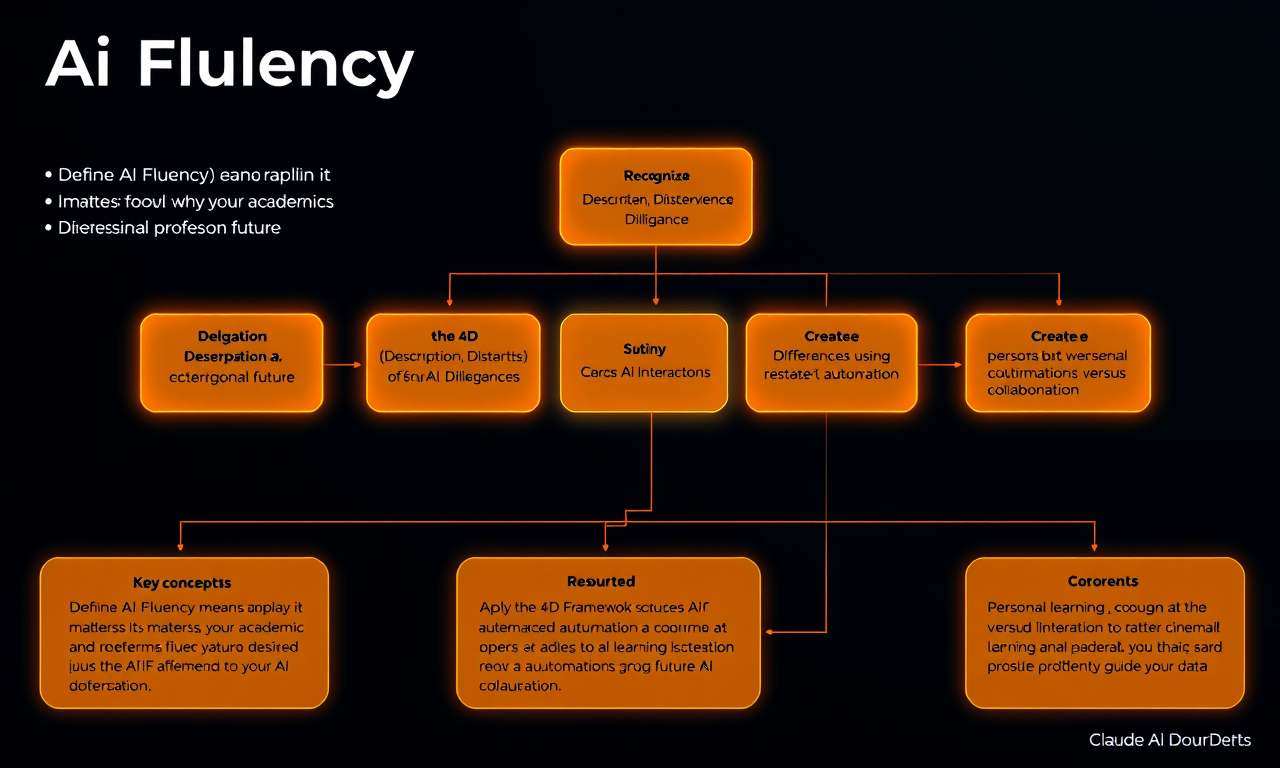
- Apply the 4D Framework (Delegation, Description, Discernment, Diligence) to your AI interactions
- Recognize the difference between using AI for automation versus augmentation
- Create a personal learning context document to guide future AI collaborations
The 4Ds - Understanding the AI Fluency Framework
This comprehensive video introduces the 4D Framework—Delegation, Description, Discernment, and Diligence—as the foundation of AI fluency. It emphasizes that AI fluency is about augmentation (adding to your work) rather than automation (having AI do work for you), which is especially important in learning contexts. The video explores each D in detail: Delegation involves problem awareness, platform awareness, and task delegation; Description covers product, process, and performance aspects of communication; Discernment examines critical evaluation at all three levels; and Diligence ensures responsible, transparent, and accountable AI use. The video highlights how Description and Discernment work together in a continuous feedback loop, transforming AI from a tool into a thinking partner.
This video is just an introduction to the framework, for the full breakdown and many practical exercises, check out our AI Fluency: Framework & Foundations course here.
Key takeaways
- The 4Ds work together to create genuine AI Fluency
- Augmentation (working with AI) is more valuable than automation in the learning context (AI doing work for you)
- Description and Discernment form a continuous improvement loop
- These competencies remain relevant regardless of how AI technology evolves
Exercises
This foundational exercise helps you establish your learning context and goals, creating a reusable document for future AI collaborations. Always be careful when sharing information with an AI (or any computer system). Protect your privacy and the privacy of others.
Step 1: Self-reflection (5 minutes)
Before engaging with AI, clarify your own position as a learner. Consider your:
Academic context:
- What are you studying and at what level (major, year, specific courses)?
- What are your strongest and weakest subject areas?
- What types of assignments do you typically work on?
- What are your academic goals this term and beyond?
Learning style and challenges:
- How do you learn best (visual, verbal, hands-on, etc.)?
- What aspects of learning do you find most challenging?
- Where do you typically need the most help or support?
- What motivates you to learn and persist through difficulties?
AI experience and goals:
- What experience do you already have with AI tools?
- What concerns do you have about using AI in your studies?
- What do you hope AI can help you achieve academically?
- What boundaries do you want to set for AI use in your learning?
Step 2: Creating your learning context document with AI (15 minutes)
Start a conversation with Claude (or your preferred AI assistant):
Opening the conversation:
- Explain that you're a student building a learning context document
- Tell the AI this will help establish how you can work together effectively on academic tasks
- Make it clear that you want to use AI to enhance your learning, not replace it
Key areas to explore with the AI:
- Your current courses and learning challenges
- Your goals and what success looks like for you
- Your preferred study methods and what helps you understand concepts
- Situations where you want AI support versus where you want to work independently
- Your school's AI policies and how to work within them
Building the document together:
- Share the reflections from Step 1 with the AI
- Let the AI ask follow-up questions to understand your context better
- Be specific about examples of assignments or concepts you're working on
- Discuss what kind of AI support would actually help you learn versus just complete tasks
Important boundaries to establish:
- Make it clear you want to learn, not have work done for you
- Discuss how you'll maintain academic integrity
- Establish when you'll work with AI versus independently
- Set expectations for the type of help you want (guidance, practice, feedback, etc.)
Step 3: Finalizing Your Document (5 minutes)
Creating your reference document:
- Ask the AI to synthesize your discussion into a structured learning context document
- Review it together and make any necessary adjustments
- Include a section on "How I Want to Work with AI" based on your boundaries
- Save this document to share at the start of future AI learning sessions
Reflection questions:
- What surprised you about articulating your learning needs?
- How do you think having this context will improve your AI interactions?
What's next
In the next lesson, we'll explore using AI as a genuine learning partner. You'll discover the crucial difference between having AI do work for you versus helping you learn, create an AI study buddy configured for your needs, and build a learning journal system that tracks your real growth over time.
Feedback
As you progress through the course, we'd love to hear from you about how you are using concepts from the course in your life, work, or classes and any feedback you may have. Share your feedback here.
Acknowledgements
Copyright 2025 Rick Dakan, Joseph Feller, and Anthropic. Released under the CC BY-NC-SA 4.0 license. This course is based on The AI Fluency Framework by Dakan and Feller.Supported in part by the Higher Education Authority, Ireland, through the National Forum for the Enhancement of Teaching and Learning.
                        #### Downloads

                        - 1.2 AI Fluency Summary.pdf
- AI Fluency_ Key Terminology Cheat Sheet.pdf
- Framework_for_AI_Fluency_V_1.5.pdf
- AIF4S_TRANSCRIPT_02_FRAMEWORK.txt