Integration
AI Fluency for nonprofits
What you'll learn
Estimated time: 45 minutes
By the end of this lesson you'll be able to:
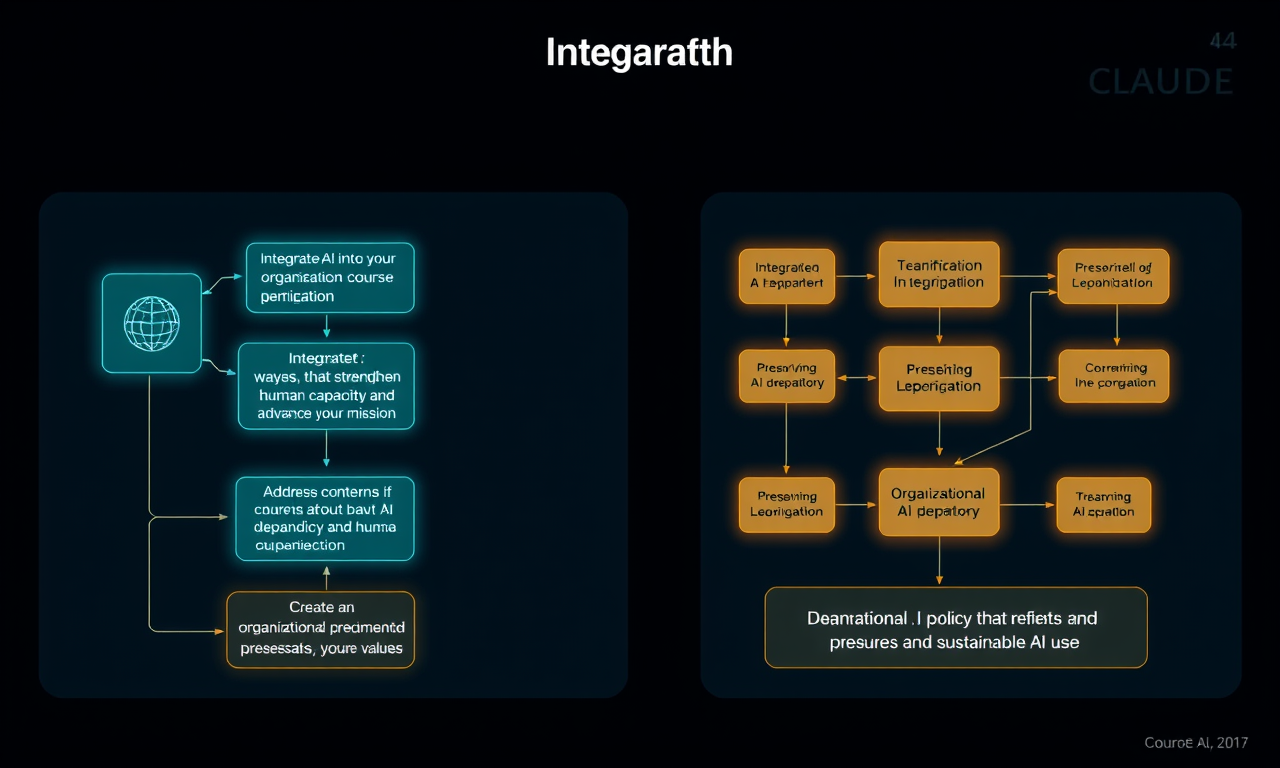
- Integrate AI into your organization in ways that strengthen human capacity and advance your mission
- Address concerns about AI dependency and preserving human connection
- Create an organizational AI policy that reflects your values and ensures sustainable AI use
Integration
(5 minutes)
This video addresses two of the most common concerns nonprofit professionals have about organizational AI adoption: How do I avoid becoming too dependent on AI? And how do we balance efficiency with the human touch? The video introduces the concept of being "the human in the loop" and what that means specifically for mission-driven organizations. It then walks through the key elements of an organizational AI policy that can help you scale AI Fluency across your team.
Key takeaways
- Being "the human in the loop" means more than oversight: In the nonprofit context, it means ensuring AI serves your mission—you decide what problems AI should help solve, you evaluate whether solutions align with your values, and you maintain the relationships and real-world impact that define nonprofit work
- Avoid dependency through understanding, not avoidance: Regularly reflect on your processes and ask "can we explain what the AI is doing?" If yes, that's healthy augmentation. If not, rework your processes until you can
- AI should free you for more human work, not less: At its best, AI cuts through noise so you can focus on the handwritten card, the personalized outreach, the time spent with individuals in your community. At worst, it automates that human touch away
- Set cultural norms around productivity early: As you bring AI into your organization, discuss expectations about what happens with time saved to ensure everyone feels good about the work AI is supporting
- An AI policy helps scale your understanding: A policy documents your decisions about platforms, task delegation, quality oversight, transparency, and values alignment so the whole organization can work consistently
Exercise: Draft your organizational AI policy
This exercise brings together everything you've learned in this course to create a practical document that can guide AI use across your organization.
Part I: Platform awareness
Answer these questions to establish your technology guidelines:
- Which AI tools will your organization use? Which are prohibited?
- What data retention and training policies are acceptable for different types of work?
- What sensitivity levels require different tools or protections?
- How will you stay informed as tools and policies change?
Part II: Task delegation
Define the boundaries of AI use:
- What types of work are appropriate for AI assistance?
- What work should stay fully human? Why?
- Who decides when a new use case is appropriate?
- How do you handle gray areas?
Part III: Expectations and capacity
Address the human side of AI integration:
- How will time saved through AI efficiency be redirected?
- What are realistic expectations for different roles?
- How will you build AI capacity across the team (not just one "AI expert")?
- What happens when AI-based workflows fail?
Part IV: Quality and oversight
Establish accountability:
- Who reviews AI outputs before they're used or shared?
- What verification steps are required for different types of content?
- What happens when AI makes a mistake?
- How will you monitor for problems over time?
Part V: Transparency
Decide how you'll communicate AI use:
- What do stakeholders, funders, and those you serve need to know about your AI use?
- How will you disclose AI involvement in specific outputs?
- What's your approach to AI attribution in grants, reports, and communications?
Part VI: Values alignment
Connect AI use to your mission:
- How do you ensure AI serves your mission rather than the other way around?
- What values and ethical principles guide your AI decisions?
- How will you maintain dignity and respect in AI-assisted work with vulnerable populations?
- When should you choose not to use AI, even if it would be more efficient?
Part VII: Compile and review
Work with AI to synthesize your answers into a draft policy document:
- Share your responses and ask AI to help organize them into a clear, usable policy
- Review the draft for completeness and alignment with your organization's voice
- Identify any gaps or areas that need further discussion with your team
- Plan how you'll introduce and revisit this policy as your organization's AI use evolves
Lesson reflection
- How has your thinking about AI integration changed from the beginning of this course?
- What's one thing you'll do differently in your work with AI based on what you've learned?
Feedback
We'd love to hear from you about how you're using concepts from this course in your work and any feedback you may have. Share your feedback here.
Acknowledgments and license
Copyright 2025 Anthropic and Giving Tuesday. Based on the AI Fluency Framework developed by Prof. Rick Dakan (Ringling College of Art and Design) and Prof. Joseph Feller (University College Cork). Released under the CC BY-NC-SA 4.0 license.