Researching With AI
AI Fluency for nonprofits
What you'll learn
Estimated time: 50 minutes
By the end of this lesson you'll be able to:
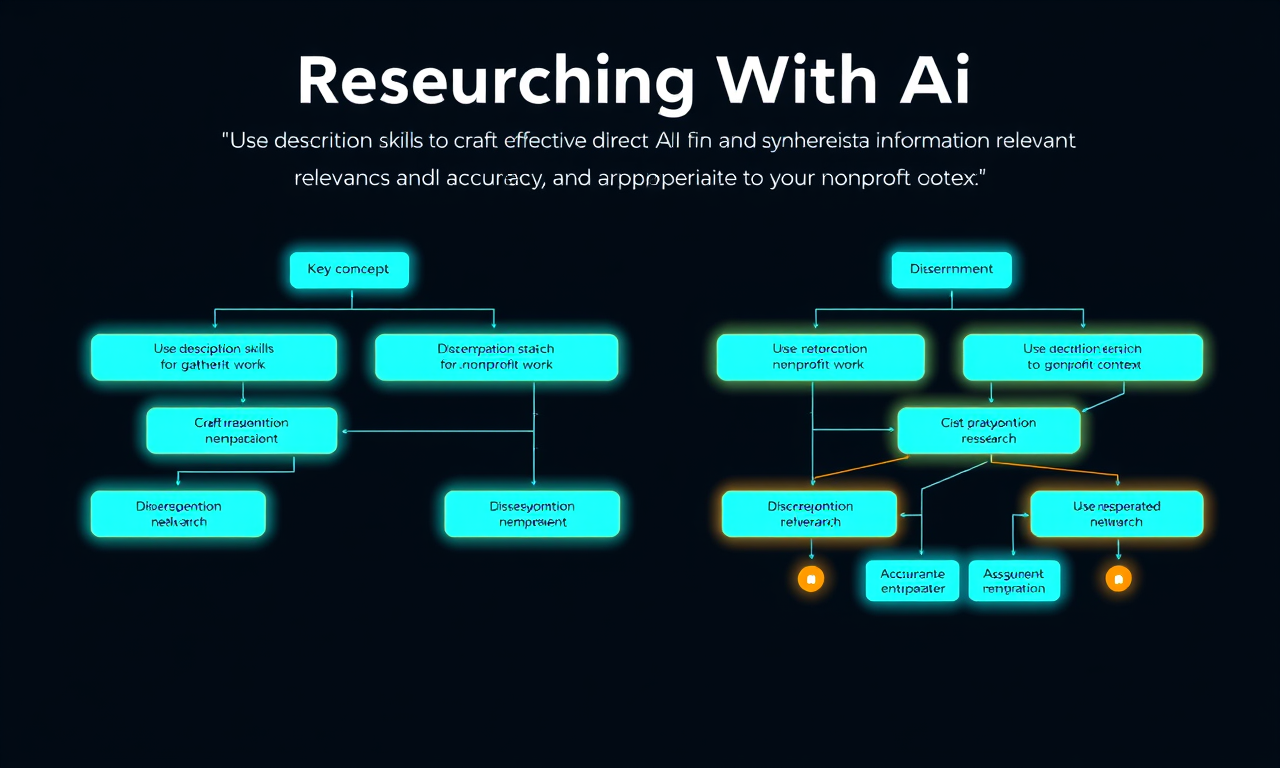
- Use Description skills to craft effective prompts that direct AI to gather and synthesize information relevant to your nonprofit work
- Use Discernment skills to evaluate AI-generated research for accuracy, relevance, and appropriateness to your nonprofit context
Researching with AI
(7 minutes)
This video demonstrates the Description-Discernment loop in action through a research scenario. You'll follow Maria, an executive director expanding her housing nonprofit from Portland to Seattle, as she uses AI to research policy landscapes, funding opportunities, and compliance requirements. The video shows how to craft context-rich prompts, evaluate AI outputs critically, and iterate toward useful results.
Key takeaways
- Effective Description provides context: Don't just ask broad questions—explain who you are, who you serve, and what you specifically need to know. This context helps AI provide relevant, actionable information
- Discernment isn't optional: You must evaluate AI outputs critically, especially when accuracy matters. Flag specific claims for verification, notice gaps, and question recency of information
- The Description-Discernment loop is iterative: Your first prompt rarely gives you everything you need. Use what you learn from evaluating each response to craft better, more targeted follow-up questions
- AI accelerates research but doesn't replace expertise: AI can help you get oriented quickly, but you're still the decision-maker who must apply professional judgment to every deliverable you own
Exercise 1: Policy and legislation tracking
This exercise helps you practice using Description and Discernment to research policy areas relevant to your nonprofit's work.
Part I: Self-reflection
Choose a policy area relevant to your work (housing policy, education funding, healthcare access, environmental regulations, etc.). Craft a research prompt that includes:
- The specific policy or legislation you want to understand
- Your nonprofit's context (who you serve, why this matters to your mission)
- What you need to know (impact on beneficiaries, funding implications, compliance requirements, advocacy opportunities)
- Time frame or geographic scope
Part II: Collaboration
Share your prompt with AI and review the response. Apply Discernment:
- Identify at least 2 claims that need verification
- Note any missing perspectives relevant to your communities
- Flag any information that seems outdated or too general
Part III: Reflection
- Did your initial prompt give AI enough context to be useful?
- What would you revise in your prompt for a second attempt?
- What verification steps would you take before using this information in your work?
Stretch goal: Ask AI to track down the original source for one key claim in its summary and compare how accurately it was represented.
Exercise 2: Donor or grant prospecting
This exercise applies Description and Discernment to fundraising research—a high-stakes area where accuracy is essential.
Part I: Self-reflection
Choose your research focus (for example: grant opportunities for a specific program, corporate donors in your region with relevant giving priorities, or foundation prospects that fund organizations like yours). Craft a research prompt that includes:
- Your organization's mission and the specific program/need seeking funding
- Your nonprofit's characteristics (budget size, geographic area, populations served)
- Funding parameters (grant size range, eligible expenses, application timing)
- What makes a "good fit" beyond just topic alignment (values, giving history, accessibility)
Part II: Collaboration
Share your prompt with AI and review the response. Apply Discernment:
- Check if suggested funders actually fund organizations of your size/type
- Verify current application deadlines and eligibility requirements
- Identify any outdated information (closed programs, changed priorities)
- Note which prospects align with your values, not just your budget needs
Part III: Reflection
- Did AI understand what makes a funder "aligned" with your mission vs. just topically related?
- What critical details would you need to verify before investing time in an application?
- What's missing from this research that only you (or your network) would know?
Stretch goal: Pick one suggested funder and ask AI to help you research their recent grants to understand their actual giving patterns vs. stated priorities.
Lesson reflection
- How did providing context about your nonprofit change the quality of AI's research output compared to a more generic prompt?
- What verification habits will you build into your workflow when using AI for research?
What's next
In the next lesson, we'll explore these same Description and Discernment skills in a different context: writing with AI. You'll see how the loop works when you're creating content rather than gathering information.
Feedback
As you progress through the course, we'd love to hear from you about how you are using concepts from the course in your work and any feedback you may have. Share your feedback here.
Acknowledgments and license
Copyright 2025 Anthropic and Giving Tuesday. Based on the AI Fluency Framework developed by Prof. Rick Dakan (Ringling College of Art and Design) and Prof. Joseph Feller (University College Cork). Released under the CC BY-NC-SA 4.0 license.