The 4D Framework
AI Fluency for nonprofits
What you'll learn
Estimated time: 30 minutes
By the end of this lesson you'll be able to:
- Explain how the AI Fluency Framework (4Ds) can be applied to nonprofit work
- Define each of the 4Ds—Delegation, Description, Discernment, and Diligence
The 4D Framework
(6 minutes)
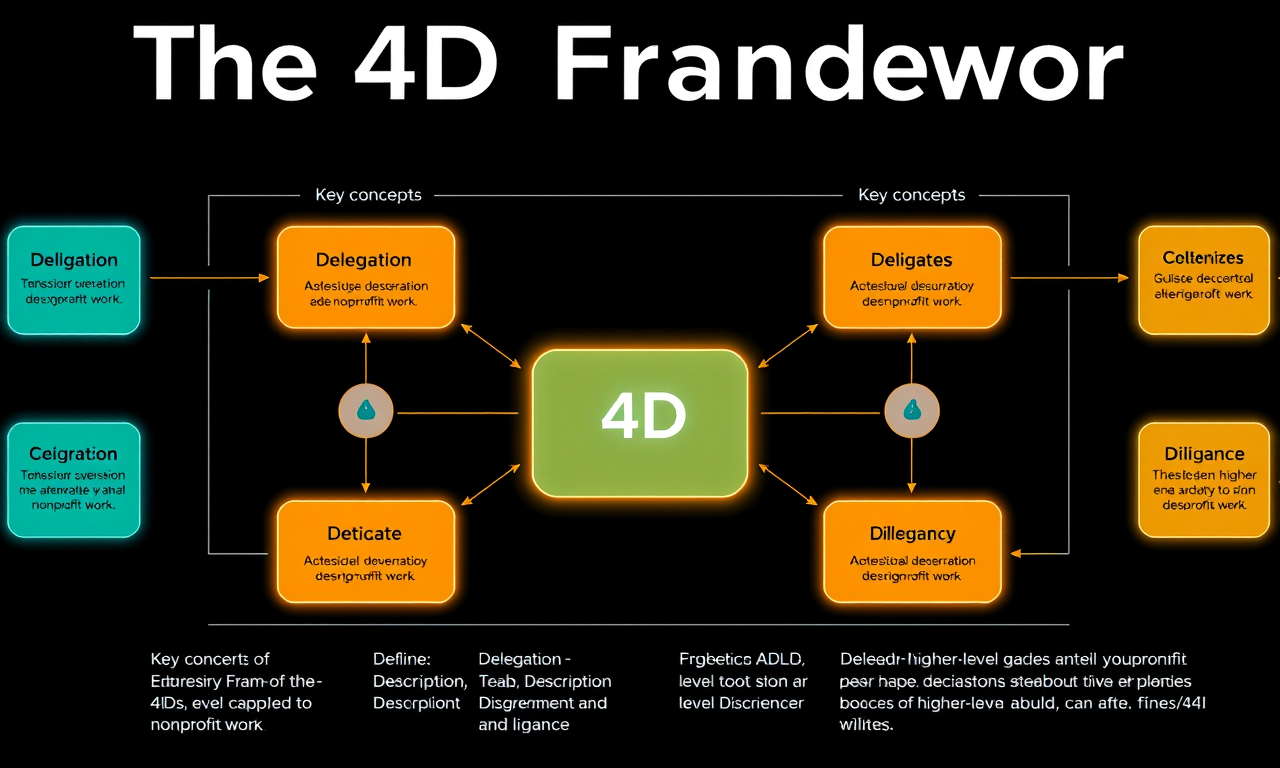
This video introduces the 4D Framework—four interconnected competencies that form the foundation of AI Fluency. You'll learn about two modes of interaction: the Delegation-Diligence loop for deciding when and whether to use AI, and the Description-Discernment loop for engaging with AI effectively day-to-day. Each competency is broken down into three sub-components with nonprofit-specific examples.
Key takeaways
- The Delegation-Diligence loop guides higher-level decisions about when to use AI Delegation involves deciding what work should be done by humans versus AI. It includes Problem Awareness (understanding your goals), Platform Awareness (knowing your tools' capabilities and limitations), and Task Delegation (distributing work thoughtfully) Diligence means taking responsibility for how you use AI. It includes Creation Diligence (being intentional about which tools you use), Transparency Diligence (being honest about AI's role), and Deployment Diligence (verifying and vouching for outputs)
- The Description-Discernment loop guides effective day-to-day interactions Description is how you communicate effectively with AI systems. It includes Product Description (defining outputs), Process Description (guiding the approach), and Performance Description (shaping AI behavior during collaboration) Discernment means critically evaluating AI's work. It includes Product Discernment (evaluating quality), Process Discernment (evaluating how AI arrived at outputs), and Performance Discernment (evaluating AI behavior)
Exercises
Exercise #1: Mapping Your AI Needs
Why? This exercise reveals which AI competencies you're already thinking about and which ones need attention, so you can strategically direct your energy where it matters most.
- Self-Reflection: Write a list of your questions and concerns about using AI
- Collaboration: Open up a conversation with AI. Ask AI "Can you help me understand where each of these questions and concerns fits within the AI Fluency 4D framework?"
- Reflection: Which of the 4 competencies did most of your questions and concerns fall into? This pattern reveals where you're currently focusing your attention. Is this where you most need to develop, or are you avoiding a harder competency that would unlock more progress? Based on the competency you identified to prioritize first, what's one specific thing you'll do differently the next time you use AI?
Exercise #2: Identify One Cross-Competency Challenge (stretch goal)
Stretch goal = understand how each time you interact with AI you are (or should be) interacting with each of these competencies in an interconnected way.
After mapping your questions across the 4Ds, identify one area where you'll need to develop multiple competencies simultaneously to move forward effectively.
For example:
- "I realize I need both Delegation skills (deciding if AI should help with volunteer communications) AND Diligence skills (ensuring we protect volunteer privacy) before I can move forward."
- "My Discernment concerns about accuracy won't matter until I develop Description skills to get better outputs in the first place."
Lesson reflection
- Looking at your mapped questions and concerns, were you surprised by which competency area dominated? What might that tell you about your current relationship with AI?
- How might the two loops (Delegation-Diligence and Description-Discernment) have changed a recent interaction you had with AI?
What's next
In the next lesson, we'll put Description and Discernment into practice as you learn to research and write effectively with AI—skills that apply directly to grant proposals, donor communications, and program materials.
Feedback
As you progress through the course, we'd love to hear from you about how you are using concepts from the course in your work, plus any feedback you may have. Share your feedback here.
Acknowledgments and license
Copyright 2025 Anthropic and Giving Tuesday. Based on the AI Fluency Framework developed by Prof. Rick Dakan (Ringling College of Art and Design) and Prof. Joseph Feller (University College Cork). Released under the CC BY-NC-SA 4.0 license.