Applying AI Fluency To Learning Materials And Assignments
AI Fluency for educators
Anthropic
  Open in Claude


                Estimated Time: 60 minutes
What you'll learn
By the end of this lesson you'll be able to:
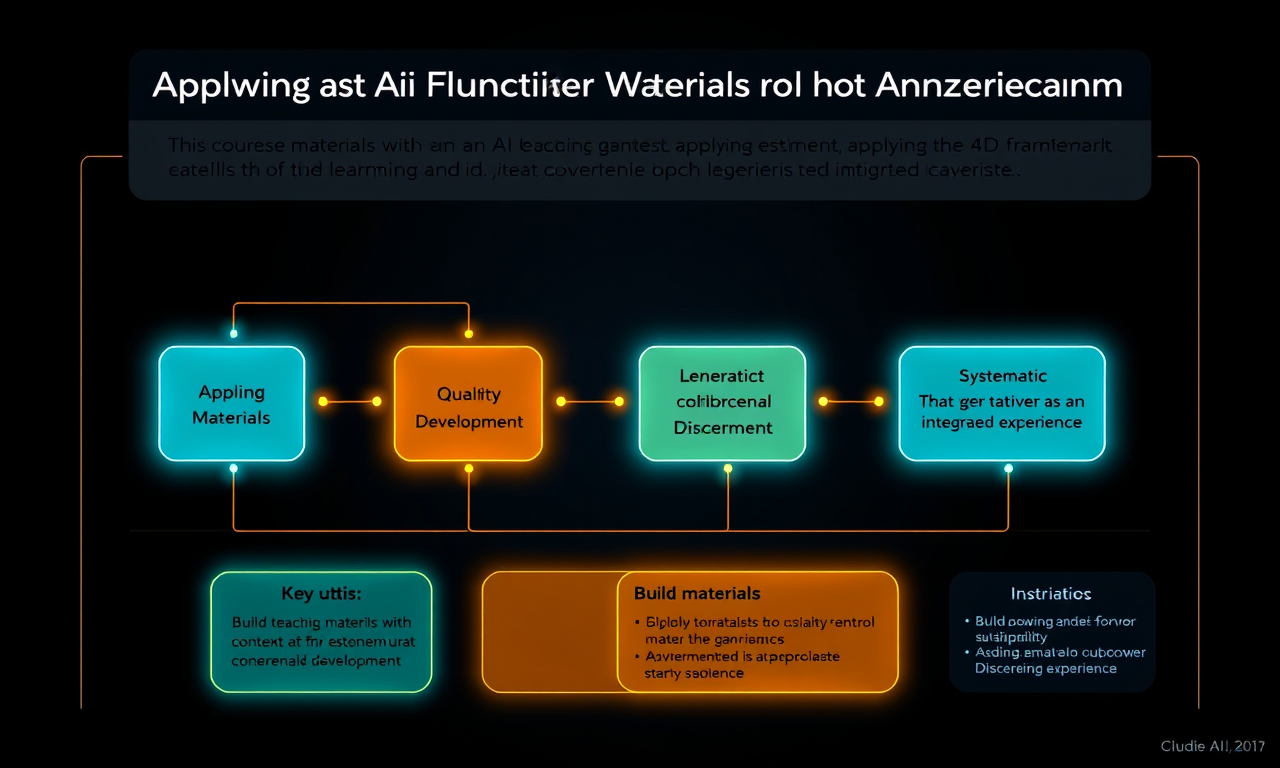
- Build teaching materials with an AI assistant applying the 4D framework
- Leverage established context for coherent material development
- Apply systematic quality control through Discernment
- Build materials that work together as an integrated learning experience
Applying AI Fluency to learning materials and assignments
(10 minutes)
This video explores using AI Fluency to create the materials students actually work with—from lecture slides to assessments. We demonstrate how the context built in previous lessons makes material creation more coherent and effective. The video shows how to apply all 4Ds to material creation: Delegation involves understanding what materials you need and why, drawing on your problem awareness and platform understanding. Description leverages your established context while adding specific requirements for each material. The Description-Discernment loop becomes a powerful refinement tool—not just accepting or rejecting AI suggestions but explaining why they work or don't for your specific students. Diligence encompasses protecting sensitive data, verifying accuracy, checking for bias, and creating transparency about AI's role. We address the challenge of maintaining academic integrity when students also have access to AI, emphasizing that fluency helps us design assessments that promote authentic learning. The video concludes by noting that while this approach saves time, the real transformation is in quality—materials that build coherently, align with objectives, and embody your pedagogical vision.
Key takeaways
- Established context makes each new workflow better than starting fresh
- The Description-Discernment loop refines materials through meaningful iteration
- Different materials require different delegation strategies
- Focus on coherence and quality, not just efficiency
Exercises
Exercise: Creating Learning Materials (50 minutes)
Continue your course (re)design conversation from lesson 2, or output a summary of that conversation to use as input for a new one. You can also share this course's video transcripts with your AI partner (see Lesson resources).
Building on this context, create one or more of these learning materials.
Option 1: Lecture Slide Deck
Setting up the task:
- Share your course context and reference the specific topic
- Explain your presentation style and classroom dynamics
- Discuss what the slides should accomplish vs. what you'll provide verbally
- Indicate any visual preferences or institutional templates
Creating and refining:
- Ask for an initial slide outline
- Evaluate: Is the flow logical? Is the complexity appropriate?
- For each slide, consider: What would you need to add or modify?
- Pick one crucial slide to develop in detail together
- Explain why certain approaches work better for your students
- Combine the results to build out the full deck
Final check:
- Verify factual accuracy
- Note where images or citations are needed
- Document how AI contributed to the deck
Option 2: Study/Revision Guide
Setting up the task:
- Reference the lecture topic you just worked on
- Describe how your students typically study
- Explain what kinds of study aids have worked well (or poorly) in the past
- Indicate whether this is for independent study or guided review
Creating and refining:
- Work with AI to identify key concepts students must master
- Develop self-check questions at varying difficulty levels
- Ask AI to anticipate common misconceptions
- Create connections to other course topics
- Evaluate whether the guide truly helps students learn independently
Final check:
- Ensure answer keys are accurate
- Verify alignment with your assessments
- Check accessibility and clarity
- Check for citations needed
Option 3: Interactive In-Class Exercise
Setting up the task:
- Describe your classroom setup and typical class size
- Explain how much time you have for the activity
- Share what kinds of interactions work well with your students
- Indicate learning goals for this specific exercise
Creating and refining:
- Collaborate on an activity that reinforces your topic
- Think through logistics: How will students form groups? Share results?
- Ask AI to help anticipate different student responses
- Develop clear instructions and timing
- Create facilitation notes for yourself
- Consider: What if the activity goes too fast? Too slow?
Final check:
- Test instructions for clarity
- Consider accessibility and different learning styles
- Plan for contingencies
Option 4: Knowledge Check Quiz
Setting up the task:
- Reference your learning objectives
- Explain what level of understanding you're assessing
- Discuss your approach to academic integrity
- Indicate whether this is formative or summative assessment
Creating and refining:
- Develop 5-10 questions of varying difficulty
- Mix question types (multiple choice, short answer, application)
- For each question, connect it to specific objectives
- Ask AI to help write clear question stems and plausible distractors
- Create detailed explanations for answers (why right answers are right, wrong are wrong)
Final check:
- Verify all answers are correct
- Check for unintended bias or confusion
- Ensure appropriate challenge level
- Consider how students might misinterpret questions
Lesson reflection:
- How did having established context affect the quality of materials generated?
- How did these materials build on and reference each other?
What's next
You've now experienced the full cycle of AI Fluency in teaching—from establishing your pedagogical context to creating coherent learning materials. In the next lesson, you'll have an opportunity to take a short quiz and earn a certificate of completion.
Ready to deepen your expertise? If you haven't already, take our comprehensive AI Fluency: Framework & Foundations course for extended practice with the 4Ds across all contexts. When you complete it, you'll earn a certificate of completion to showcase your AI fluency skills to colleagues and administrators.
Finally, if you're curious about bringing AI Fluency to your students, check out our Teaching AI Fluency course.
Feedback
As you progress through the course, we'd love to hear from you about how you are using concepts from the course in your life, work, or classes and any feedback you may have. Share your feedback here.
Acknowledgements
Copyright 2025 Rick Dakan, Joseph Feller, and Anthropic. Released under the CC BY-NC-SA 4.0 license. This course is based on The AI Fluency Framework by Dakan and Feller.Supported in part by the Higher Education Authority, Ireland, through the National Forum for the Enhancement of Teaching and Learning.
                        #### Downloads

                        - AIF4E_TRANSCRIPT_04_MATERIALS.txt