Applying Discipline Expertise To AI Fluency
Teaching AI Fluency
Anthropic
  Open in Claude


                ## What you'll learn
Estimated time: 40 minutes
By the end of this lesson you'll be able to:
- Apply your disciplinary expertise to create field-specific applications of the 4Ds
- Collaborate with colleagues to build shared understanding of AI Fluency in your department
Applying discipline expertise to AI Fluency
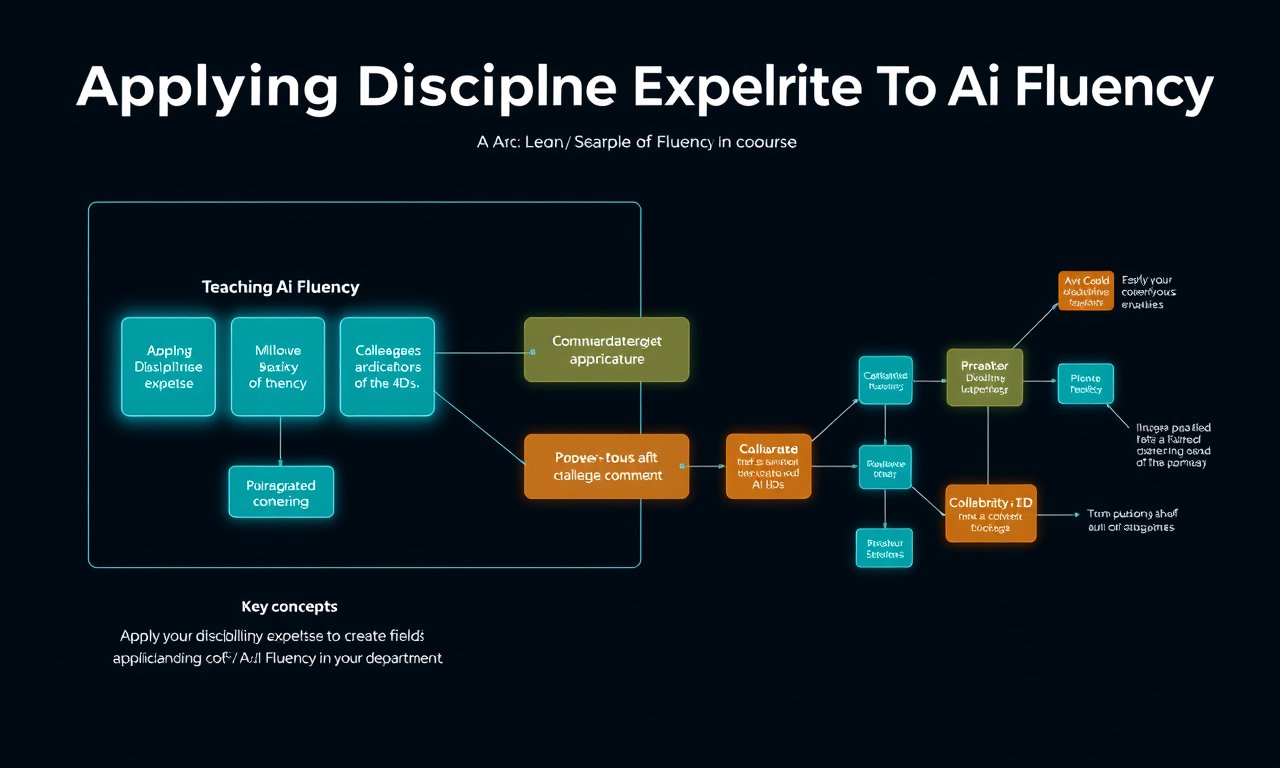
This video demonstrates how to apply your deep disciplinary knowledge to make the AI Fluency Framework specific to your field. It emphasizes that developing discipline-specific AI Fluency happens through making tacit knowledge explicit—articulating what quality looks like, how experts communicate, what problems matter, and what standards apply. The video shows how to work with colleagues to build shared understanding of each D in your discipline: defining quality criteria for Discernment, mapping communication norms for Description, understanding work decomposition for Delegation, and codifying ethical standards for Diligence. It emphasizes that this deep disciplinary work creates a feedback loop where students who can articulate quality standards can better evaluate any output, those who understand methods can guide any process, and those who've internalized ethics can navigate any collaboration responsibly. The video concludes by noting that preparing students to be irreplaceable means developing these uniquely human capabilities.
Key takeaways
- Making tacit disciplinary knowledge (e.g. best practices, ethics, research genres, etc.) explicit prepares students for effective AI collaboration
- Each of the 4Ds requires discipline-specific interpretation and application
- Collaborative work with colleagues builds shared understanding and stronger frameworks
- Students who understand quality, methods, and ethics in your field can better direct AI
- The goal is preparing students to be irreplaceable by developing uniquely human capabilities
Exercises
For our final exercise we’re going to give our AI partners a break and just talk to our human colleagues!
However, having all participants work through the exercise from the previous lesson individually will facilitate these conversations.
In whatever manner makes sense for your context, schedule some organized time to work through the 4D framework with your colleagues.
Here are some suggested topics to help guide your discussion:
For Discernment - "What does quality look like in our field?"
- Work together to articulate what excellence means in your discipline beyond vague terms
- Identify specific features that distinguish outstanding work from mediocre work
- Discuss how to teach students to recognize these quality markers
- Document criteria that could help students evaluate both human and AI-generated work
For Description - "How do we communicate in our discipline?"
- Map the key products in your field with precision (e.g. not just "reports" but specific artefacts and why they matter)
- Document the thought processes experts use when approaching problems in your field
- Identify the behavioral norms and conventions that define professional practice
- Explore how to make these communication patterns explicit for students
For Delegation - "What work happens in our field?"
- Break down typical tasks in your discipline into component parts
- Identify which elements require human judgment, creativity, or expertise
- Discuss where AI could automate, augment, or act as an agent
- Create decision frameworks for when and how to involve AI in disciplinary work
For Diligence - "What are our field's values and standards?"
- Codify ethical frameworks specific to your discipline
- Clarify transparency norms and disclosure expectations
- Discuss accountability standards and professional responsibilities
- Consider how these apply when AI is involved in the work
Building a shared document:
- Compile the discipline-specific interpretations of each D
- Include concrete examples from your field for each competency
- Add teaching strategies that colleagues suggest for developing these competencies
- Identify areas where you have consensus and where perspectives differ
- Consider how to share this work with students to make AI Fluency concrete
- Discuss how to integrate these discipline-specific 4Ds into curriculum
- Consider how to assess whether these frameworks are helping students
- Agree on next steps to continue the discussion and implement new initiatives
What's next
You've completed our teaching AI Fluency course! Take the final quiz in the next lesson to earn a certificate of completion.
Feedback
As you progress through the course, we'd love to hear from you about how you are using concepts from the course in your life, work, or classes and any feedback you may have. Share your feedback here.
Acknowledgments and license
Copyright 2025 Rick Dakan, Joseph Feller, and Anthropic. Released under the CC BY-NC-SA 4.0 license. This course is based on The AI Fluency Framework by Dakan and Feller.Supported in part by the Higher Education Authority, Ireland, through the National Forum for the Enhancement of Teaching and Learning.
                        #### Downloads

                        - TAIF_TRANSCRIPT_07_DISCIPLINE.txt