Introduction To AI Fluency For Educators
AI Fluency for educators
Anthropic
  Open in Claude


                Estimated Time: 30 minutes
What you'll learn
By the end of this lesson you'll be able to:
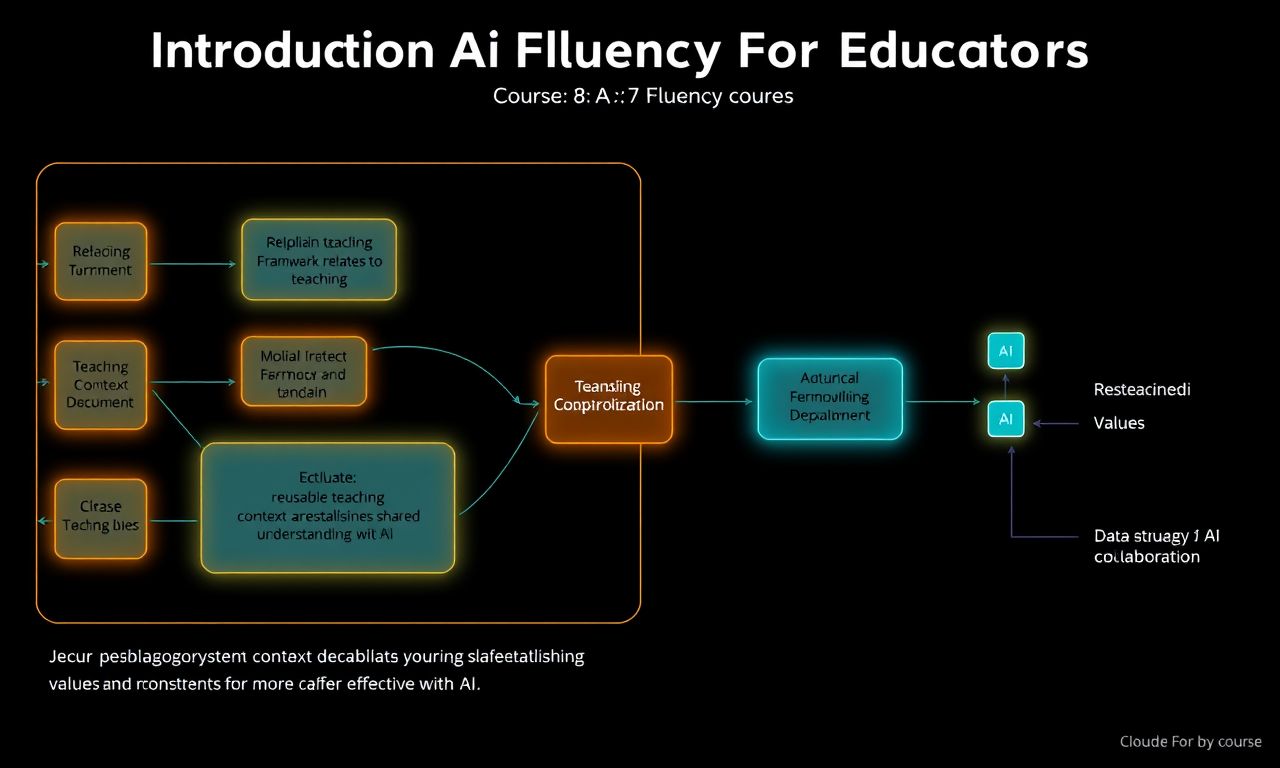
- Explain how the AI Fluency Framework (4Ds) relates to teaching
- Create a reusable teaching context document that establishes shared understanding with AI
- Articulate your pedagogical values and constraints for more effective AI collaboration
Introduction to AI Fluency for Educators
(4 minutes)
This video introduces how the AI Fluency Framework applies specifically to educators. We explore how the 4Ds (Delegation, Description, Discernment, Diligence) can transform your teaching practice through thoughtful AI collaboration. We discuss how AI can become a thinking partner for course design, material creation, and assessment development while maintaining the balance between human expertise and AI assistance. The video emphasizes that being AI Fluent includes knowing when and how to collaborate with AI and always keeping pedagogical values at the center. We also address why AI Fluency in education matters now: Students are already using AI, employers expect AI fluency, and we have the timely opportunity to model thoughtful engagement with these technologies.
Key takeaways
- The 4D Framework can help educators build genuine thinking partnerships with AI on the foundation of pedagogical integrity
- Context-building is essential as AI becomes more helpful when it understands your specific situation, values, and constraints
- AI Fluency for educators means enhancing rather than replacing human expertise and judgment in teaching and learning
Exercises
Exercise: Building a shared teaching vision (30 minutes)
This foundational exercise is good for fostering reflection and creates a reusable artifact for future AI collaborations.
Part 1: Self-Reflection (10minutes)
Before engaging with AI, clarify your own position:
- What are your core teaching values and philosophy?
- What unique constraints do you face (institutional, technological, time)?
- What are your students typically like (background, challenges, goals)?
- What teaching methods/learning experiences do you most value and why?
Part 2: Discuss your teaching values and context (25 minutes)
Start a conversation with Claude (or any other AI assistant you choose):
Opening the conversation:
- Explain that you're an educator who wants to build a reusable summary of their teaching approach and context
- Let the AI know this document will help establish shared understanding for future collaborations
- Indicate you'd like the AI to help you think through all relevant aspects of your teaching practice
- You can ask the AI to interview you about your teaching, OR
- You can just start sharing information and ask the AI what else would be helpful to know
Take your time. The goal is a back-and-forth conversation that surfaces important context.
Key areas to cover (the AI should help you explore these):
- Your subject area, level, and specific courses
- Typical challenges faced by your students
- Institutional context and constraints
- Your teaching philosophy and preferred methods
- Common pain points in your teaching
- Goals for integrating AI into your practice
- Any unique aspects of your teaching situation
Make it conversational:
- Don't feel you need to share everything at once
- Encourage the AI ask follow-up questions
- Share specific examples when they help illustrate your context (be aware of privacy and sensitive data)
- It's okay to think out loud and refine your thoughts as you go
Creating a reusable document:
- Ask the AI to synthesize the conversation into a structured context document you can share in future AI conversations
- Review it together and add anything missing and/or make corrections
- Request a format that's easy to copy and reuse
Lesson reflection
- What aspects of your teaching practice were hardest to articulate?
- What became clearer to you through this process?
What's next
The next lesson will cover a quick review of the 4D framework — Delegation, Description, Discernment, and Diligence. If you've already taken the AI Fluency: Framework & Foundations course, and feel comfortable with this content, you can skip the next lesson!
Feedback
As you progress through the course, we'd love to hear from you about how you are using concepts from the course in your life, work, or classes and any feedback you may have. Share your feedback here.
Acknowledgements
Copyright 2025 Rick Dakan, Joseph Feller, and Anthropic. Released under the CC BY-NC-SA 4.0 license. This course is based on The AI Fluency Framework by Dakan and Feller.Supported in part by the Higher Education Authority, Ireland, through the National Forum for the Enhancement of Teaching and Learning.
                        #### Downloads

                        - AIF4E_TRANSCRIPT_01_WELCOME.txt