Next Steps
AI Capabilities and Limitations
What you'll learn
Estimated time: 20 minutes
By the end of this lesson you'll be able to:
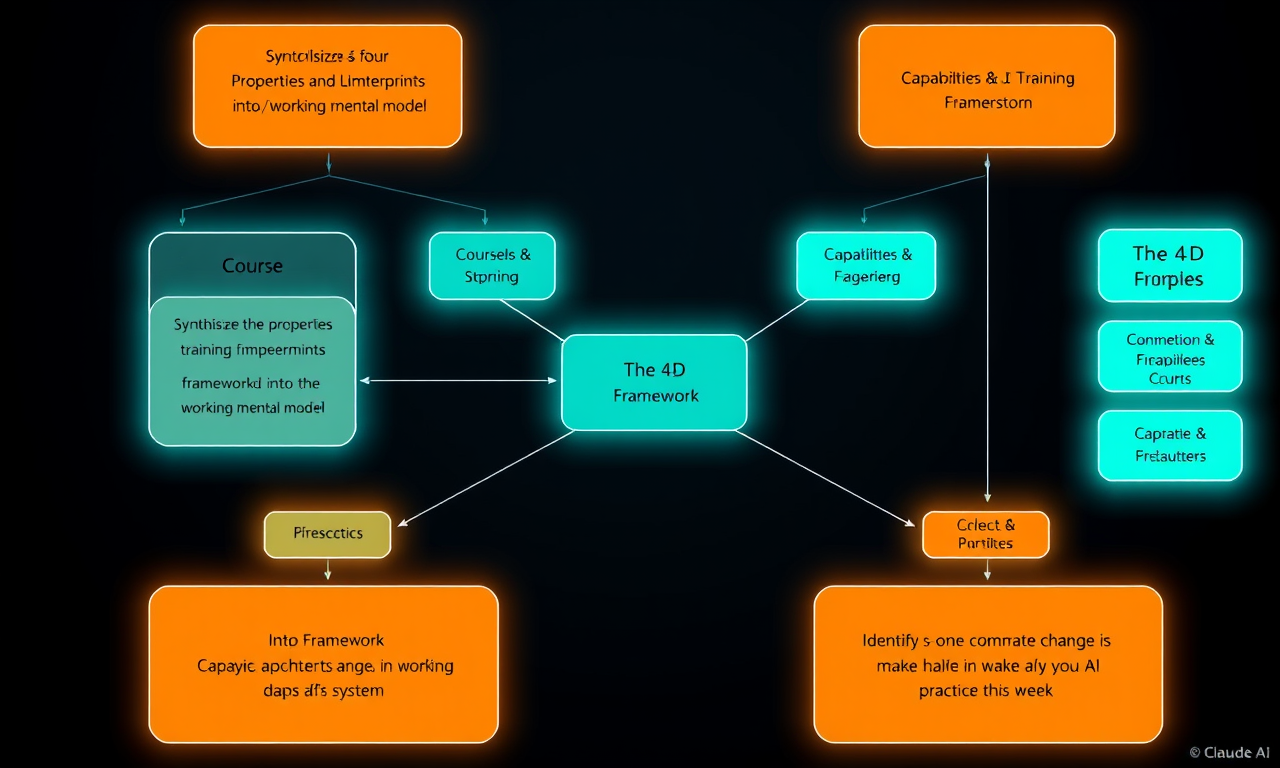
- Synthesize the four properties and training fingerprints into a working mental model
- Connect the Capabilities & Limitations framework to the 4D Framework as two halves of one system
- Identify one concrete change to make in your AI practice this week
A small model of the machine
AI Capabilities & Limitations Framework Four properties that shape what AI can and can't do for you. Each sits on a spectrum — the further right, the more you should verify and compensate.
CapabilityLimitation
Next Token PredictionWhere do AI answers come from?
Well-worn paths: summarize, reformat, explain common conceptsNovel territory, sparse patterns, "true vs. sounds true"

KnowledgeWhat does AI actually know?
Frequent, recent-in-training, consistent: mainstream topics, popular languagesRare, post-cutoff, niche, local, or contested topics
Working MemoryWhat is the AI paying attention to right now?
Material fits comfortably, session is current, you supply relevant contextVery long docs/conversations, expecting cross-session continuity (the cliff)
SteerabilityHow much am I in control?
Short, concrete, verifiable instructions ("respond as a table," "under 100 words")Long reasoning chains, abstract asks, native precision
You came in with some version of one question: why does AI do that? You're leaving with a structure that lets you answer the next one yourself.
What you're taking with you. Two training stages: pretraining builds a document completer, fine-tuning layers an assistant on top—every behavior traces back to one of those fingerprints. Four properties as continuums: Next Token Prediction, Knowledge, Working Memory, Steerability, each with a capability zone, a limitation zone, and product features pushing the edge further out. And when something goes wrong, it's almost always two properties meeting. Diagnose by asking which two collided?—not what broke?
Two halves of one system. The 4D Framework and this course aren't separate things to juggle. The 4Ds are what you do; the four properties are what you're responding to when you do them. Next Token Prediction sharpens Discernment (fluency and accuracy are independent variables). Working Memory sharpens Description (context is leverage, and the model doesn't remember everything). Steerability sharpens Delegation (you know where control is tight and where it's loose). The machine layer sharpens the human layer—opposite sides of the same coin.
Calibrated trust is a habit, not an attitude. Before handing something to AI, run a quick internal check: well-worn territory or sparse? Recent topic or stable? Context comfortably inside the window? Instructions concrete, or room between words and intent? Then adjust—more verification where fabrication concentrates, more context where the model can't guess, more checkpoints where reasoning runs long. You don't trust the AI. You don't distrust it either. You locate the task and set your habits accordingly.
The shape stays useful. Models will keep changing. Context windows grow, hallucination rates drop, features close gaps. But AI will keep being a predictor whose fluency runs ahead of its accuracy, with uneven knowledge and a cutoff, working inside a finite window, following instructions through a gap between words and intent. Those facts don't expire when the version number goes up. You've built a mental model that's durable on purpose.
Key takeaways
- You now hold a working mental model: four properties as continuums, characteristic failures as property intersections.
- This framework and the 4D Framework are two sides of one system. The properties explain what the 4D competencies are responding to.
- Calibrated trust means locating your task on each continuum and matching your verification and context habits to where it sits.
- Models will keep changing. The shape of these properties stays useful even as the exact boundaries shift.
Exercises
Exercise: Your Commitment
Return one last time to your task list from Lesson 1. For each task, jot a quick gut-read: where does the task land on each property's continuum, and what mitigations might you need?
Now, pick one task and one change you'll make this week (a verification step, a standing-context setup, a checkpoint, a goal-stated-not-just-format habit). Write it down.
Lesson reflection
- What's the single biggest shift in how you think about AI behavior from Lesson 1 to now?
- Which of the 4Ds feels most immediately sharpened by what you've learned here?
What's next
If you haven't yet taken the AI Fluency Framework & Foundations course, that's the natural next step. It goes deep on the human competencies this course gave you the machine-side context for. And keep testing edges: the properties stay stable, but where the lines sit will keep moving as models improve.
Feedback
As you progress through the course, we'd love to hear from you about how you are using concepts from the course in your work, plus any feedback you may have. Share your feedback here.
Acknowledgments and license
Copyright 2026 Anthropic. Original work building on the AI Fluency Framework developed by Prof. Rick Dakan (Ringling College of Art and Design) and Prof. Joseph Feller (University College Cork). Released under the CC BY-NC-SA 4.0 license.