Intro To AI Capabilities And Limitations
AI Capabilities and Limitations
What you'll learn
Estimated time: 15 minutes
By the end of this lesson you'll be able to:
- Understand what this course covers and how it's structured
- Explain why this material is durable even as models and products keep changing
- See how the Capabilities & Limitations framework and the 4D Framework work together
A mental model of the machine
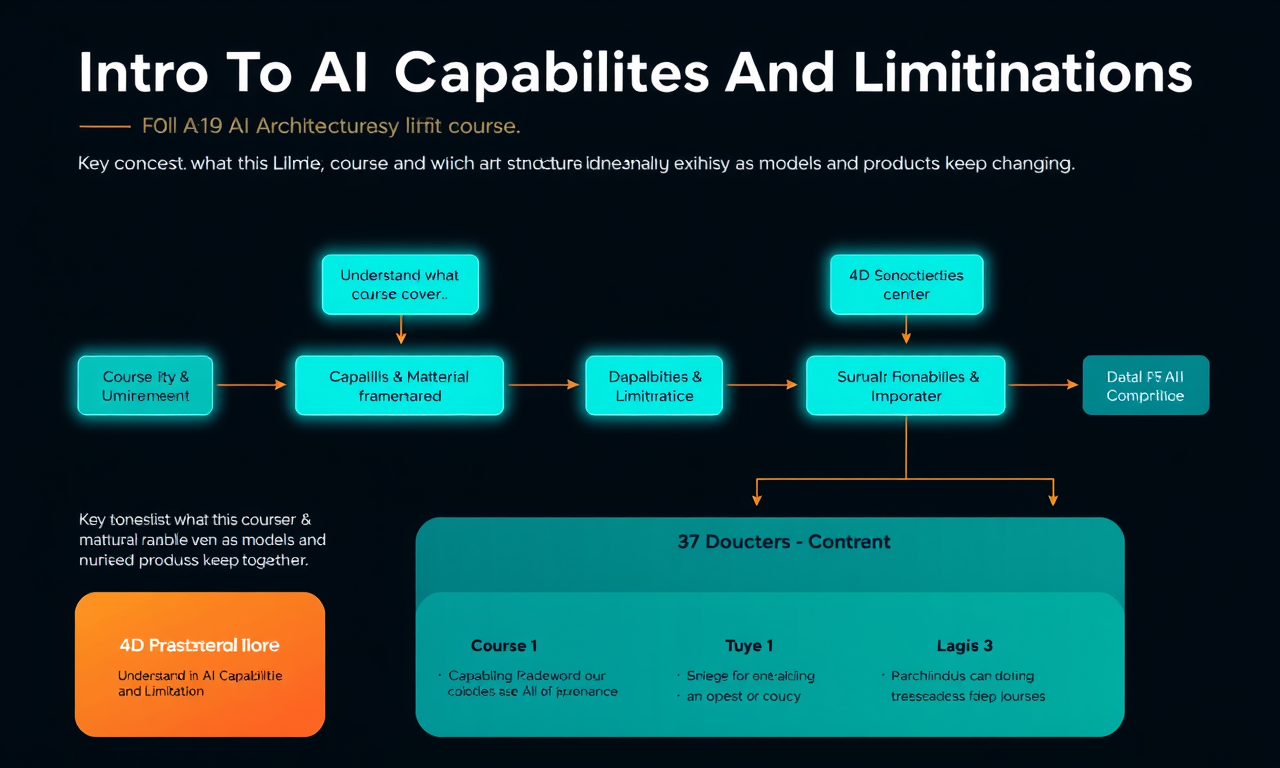
Courseroadmap
What we mean by AIWhat is generative AI and how does it differ from other types of AI?
How AI is trainedHow do pretraining and fine tuning give AI its character?
Properties of AIWhat are next token prediction, knowledge, working memory, and steerability?
Putting it all togetherWhat happens when properties collide in real life situations?
Next stepsHow do you use this knowledge to use AI safely, effectively, and ethically?
If you've taken the AI Fluency Framework & Foundations course, you already know the 4Ds—Delegation, Description, Discernment, and Diligence—the human competencies for collaborating with AI. This course is the companion piece: it's about what the machine does when you prompt it, and why. The two frameworks fit together. You can't delegate a task well without knowing where a model is strong or weak, and you can't discern output quality without some picture of how that output was produced. Everything you learn here is actionable through the 4Ds.
We'll start with the two training stages—pretraining and fine-tuning—that give an AI its character. Then we'll cover four core properties: Next Token Prediction, Knowledge, Working Memory, and Steerability, each a continuum you'll learn to place your own tasks along. Finally, we'll look at how these properties interconnect, since most real-world failures are two properties meeting (a hallucinated citation is Next Token Prediction meeting a Knowledge gap). Models will keep changing, but the shape of these properties stays useful—that's what makes this a durable mental model. To get the most out of the course, bring real tasks to the exercises. The goal is a calibration you can feel, not a list of terms you memorize.
Key takeaways
- The AI Fluency Framework (4Ds) describes human competencies. This course describes the machine properties those competencies respond to.
- Generative AI has four core properties: Next Token Prediction, knowledge, working memory, and steerability.
- This material is durable because the properties stay stable even as models improve. Boundaries shift but the properties remain the same.
Exercises
Exercise: Mapping Your Current AI Use
Why? This is the foundation for every exercise that follows in this course.
- List 4–6 tasks you've actually used AI for in the last two weeks. If you haven't used AI much yet, list tasks you'd like to use it for. Be specific: "drafted a client email explaining a project delay" tells you something. "Writing" doesn't.
- For each task, note one line: did the output land on the first try, or did you need to rework it before it was usable? Don't overthink this. A quick gut check is fine.
- Now share your list with Claude (or any AI assistant) and ask: "For each of these tasks, what's one way this could go wrong if I'm not paying attention?" See if the failure modes it names feel relatable. If they don't, push back: "That doesn't match my experience. Here's what actually went wrong..."
Hold onto this list. You'll return to it in every lesson, and it'll look different each time you do.
Lesson reflection
- Which of your listed tasks felt "safe" to hand to AI, and which felt risky? Can you articulate why yet?
- What's one AI behavior you've noticed (good or bad) that you couldn't explain at the time?
What's next
Before the four properties, we need to draw a line around what "AI" means in this course. We're talking specifically about generative AI and how it's different from other forms of AI.
Feedback
As you progress through the course, we'd love to hear from you about how you are using concepts from the course in your work, plus any feedback you may have. Share your feedback here.
Acknowledgments and license
Copyright 2026 Anthropic. Original work building on the AI Fluency Framework developed by Prof. Rick Dakan (Ringling College of Art and Design) and Prof. Joseph Feller (University College Cork). Released under the CC BY-NC-SA 4.0 license.
                        #### Downloads

                        - AI Capabilities & Limitations Framework Overview.pdf